|

| |
Vibration standards (some examples at left) set guidelines for "allowable" vibration
velocities in different sorts of vibration settings (e.g. blasting, construction, traffic, etc) and, in some cases, for different building types. They can be very valuable when chosen and applied properly. But, when we consider the number of different factors which influence the potential danger of a given vibration and the ways different types of
building structures respond to vibration, it becomes
clear that standards can only be considered as reasoned guidelines, at best. They are not hard-and-fast rules which can be implemented without regard for their known, and largely admitted, limitations or, worse yet, by ignoring
the cautions offered in the scientific studies behind the standards. Prudence demands that, when it comes to the safety
of the home of someone else who just happens to live near the construction zone, standards should be applied in a manner that is both conservative and appropriate to the type of work being done. That use should be scientifically supportable, with well-acquired
data and consistent with minimizing the chance of damage in every reasonable way. Readers of this chapter should also read the Vibration and Distance chapter, which discusses how vibration varies with distance and the
calculations which are used to estimate vibration PPV's.
"Safe Distances" 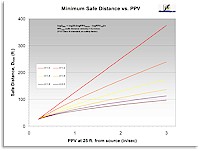 The peak particle velocity of a
vibration is considered the best indicator of its damage potential, even if the specific levels of acceptable vibration velocity vary depending upon the previously discussed factors and more. Indeed, setting acceptable levels of
vibration is a complex process, with many conditions and uncertainties. However, since it is hard for people to know whether the velocities of vibrations
are "safe" just from feeling them (see Judging Vibrations for some help in distinguishing those vibrations which are usually "safe" from those which may be damaging) and vibration monitoring is too often not
carried out during construction, it is often easier to think in terms of "safe distances" from vibration-causing work. The peak particle velocity of a
vibration is considered the best indicator of its damage potential, even if the specific levels of acceptable vibration velocity vary depending upon the previously discussed factors and more. Indeed, setting acceptable levels of
vibration is a complex process, with many conditions and uncertainties. However, since it is hard for people to know whether the velocities of vibrations
are "safe" just from feeling them (see Judging Vibrations for some help in distinguishing those vibrations which are usually "safe" from those which may be damaging) and vibration monitoring is too often not
carried out during construction, it is often easier to think in terms of "safe distances" from vibration-causing work.
In the absence of carefully-done vibration monitoring work, safe distances are certainly easier to
observe and document (either manually or by use of the computer software Google Earth) than vibration velocities, which require a properly installed seismograph for measurement. Safe distances are usually based on calculations of
distances at which vibration velocities are expected to drop below a given standard limit; any calculated safe distance should include an additional safety factor to account for aspects of the vibration propagation
which are not easily included in the equations used to calculate the velocities.
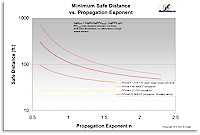 We have calculated some safe distances as a function of the vibration propagation exponent in the FTA equation (1.5 in the FTA equation), as shown at
left. [7] In this example, the target velocity chosen
was that of the FTA Class III standard for timber-framed homes of 0.2 in/sec. Distances below the curves for each equipment type shown are considered "unsafe", while those above are considered "safe" within the limitations of the
calculations. 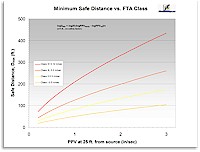 The diagram at right, also calculated from the FTA equation, shows how the safe distance varies with PPV as a function of the FTA building
Class type. You can check out, and download full size versions of, several other graphics of this sort from our online Vibration and Distance chapter. You can also get a free download of a PDF of all our vibration plots or calculate
your own numbers for both construction and blasting with our free Vibrationdamage.com Ground Vibration PPV and Safe Distance Calculator, which also includes a blasting vibration calculator and a blasting damage
probability calculator. Direct links to these and other tools can be found in the Vibration Analysis Tools chapter of the CVDG Pro. Just below are some safe distances, calculated using the FTA
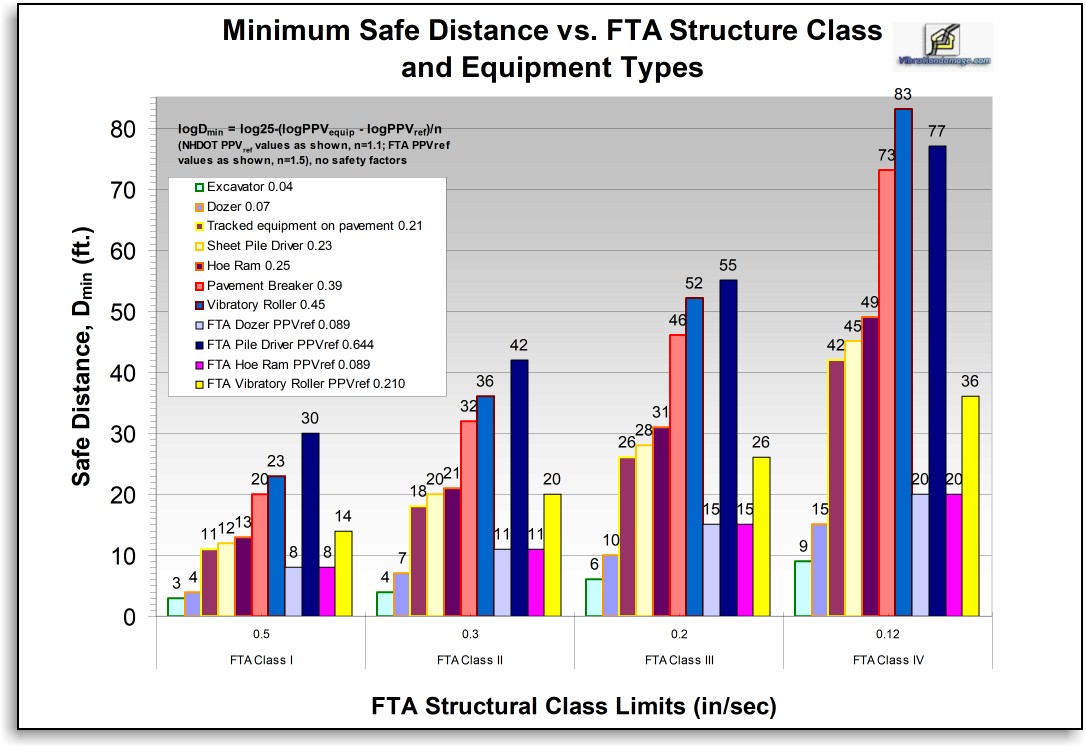
Propagation equation for various types of construction heavy equipment use for the four building types classes of the U.S. Federal Transit Administration standard, as shown below.
FTA Structure Classes Class I. Reinforced-concrete, steel or timber (no plaster)
Class II. Engineered concrete and masonry (no plaster)
Class III. Non-engineered timber and masonry buildings
Class IV. Buildings extremely susceptible to vibration damage |
Most wood-framed homes would fit into Class III. Any home previously damaged by construction vibration, or by any other form of vibration (e.g. earthquakes), should be considered to be in Class IV, as should any
historic home, consistent with
published statements about the
proper use of the Swiss standards on which the
FTA limits are based.[8] 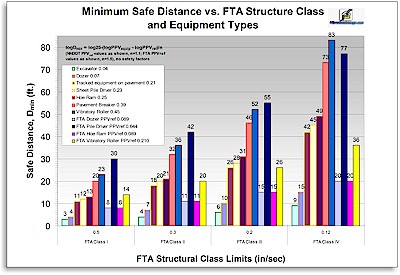
In this and our other safe distance diagrams, distances from the work to the site of
interest greater than the relevant calculated numbers can be considered "safe", within the limitations of the calculation algorithms. Those distances less than the numbers are considered "unsafe". These distances
should be multiplied by a factor of two to provide a safety factor, given the many potential uncertainties in these, and any other, vibration attenuation calculations. Inspection of the diagram will show that there are
often dramatic differences between the safe distances calculated using the FTA reference velocities for some equipment types and those calculated with the more current NHDOT reference velocities. Since the NHDOT reference
velocities are usually higher, the safe distances derived from them are probably both more reflective of modern equipment and more conservative.
You can find this diagram and additional ones calculated as a function of other
variables from the FTA vibration propagation equation on our page at
https://vibrationdamage.com/vibration_and_distance.htm. Additional ones can be downloaded free and at full size from the links in the CVDG Pro's Vibration Analysis Tools chapter. You can also obtain free from the same CVDG Pro
chapter the Vibrationdamage.com Ground Vibration PPV and Safe Distance Calculator. With it, you can calculate your own safe distances, using measured or reference values for the PPV and the distances from the work to the
structures, plus blasting PPV's, scaled distances and damage probabilities.
The safe distance depends on many
factors, some of which relate to the intensity of the source vibration; others reflect the many variables which can affect vibration attenuation in the ground. 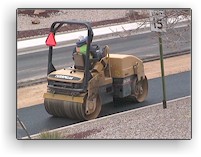 A surface mine blast using 500 pounds of ANFO[2] will have a smaller safe distance than one using 1000 pounds. A vibratory compactor operating
at low or medium "amplitude" (i.e. vibration intensity) over asphalt (e.g. compactor shown at right) has a different safe distance than one operating at high amplitude over soil. A compactor operating at a
compaction frequency below 40 Hz has a larger safe distance than one operating and producing vibrations with frequencies above 40 Hz.[3] A surface mine blast using 500 pounds of ANFO[2] will have a smaller safe distance than one using 1000 pounds. A vibratory compactor operating
at low or medium "amplitude" (i.e. vibration intensity) over asphalt (e.g. compactor shown at right) has a different safe distance than one operating at high amplitude over soil. A compactor operating at a
compaction frequency below 40 Hz has a larger safe distance than one operating and producing vibrations with frequencies above 40 Hz.[3] I have suggested as a rough guideline, in several places within the CVDG, that any construction work involving heavy equipment which you can hear may be
close enough (typically, 500-1000 feet) to be of concern for damage in at least some circumstances. However, in other places and vibration environments, the safe distance may extend much further than that guideline. For example,
safe distances have been suggested to
be several miles for mine blasting in an area of the U.S. state of Florida with a high water table and low vibration wave "attenuation" (i.e. decrease of the vibration wave intensity with distance).[1]
Blasting Safe Distances
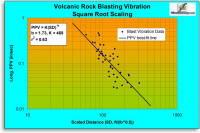 In the mining industry, safe distances are often
estimated by calculation using "scaled distance equations" (like the example at left) or related vibration propagation equations (see Vibration and Distance and Calculating Vibration Amplitudes in the CVDG Pro for more
information on such calculations). This approach allows the to find that distance at which a vibration velocity measured near the mine is expected to drop below the acceptable velocity
limits of a standard (usually the OSM standard for mining in the U.S.). The scaled distance approach for mining allows the mine operator to take into account
different "charge weights per delay" (different amounts of explosive used in each of multiple delay times between the many charge explosions which make up a single "shot") than ones for which vibration data have been obtained. Responsible mine operators
usually increase their safe distance over the calculated one to
provide a safety factor or to reduce vibration complaints from nearby homeowners.[4] The safety factor also helps take into account difficultly predictable geological variations and wave
reflection and interference effects
which can act to increase or decrease the velocity felt at certain locations over others at the same distance not experiencing such effects.[5] In the mining industry, safe distances are often
estimated by calculation using "scaled distance equations" (like the example at left) or related vibration propagation equations (see Vibration and Distance and Calculating Vibration Amplitudes in the CVDG Pro for more
information on such calculations). This approach allows the to find that distance at which a vibration velocity measured near the mine is expected to drop below the acceptable velocity
limits of a standard (usually the OSM standard for mining in the U.S.). The scaled distance approach for mining allows the mine operator to take into account
different "charge weights per delay" (different amounts of explosive used in each of multiple delay times between the many charge explosions which make up a single "shot") than ones for which vibration data have been obtained. Responsible mine operators
usually increase their safe distance over the calculated one to
provide a safety factor or to reduce vibration complaints from nearby homeowners.[4] The safety factor also helps take into account difficultly predictable geological variations and wave
reflection and interference effects
which can act to increase or decrease the velocity felt at certain locations over others at the same distance not experiencing such effects.[5]
Is it okay to go inside the safe distance a little? This is equivalent to asking if it is okay to exceed vibration PPV limits "a little". Although the 5% probability of damage at the OSM blasting limits may seem small, it is also
the PPV at which the first damage was observed in the important blasting study USBM RI 8507.[9] Exceed the limits at your peril!
Safe Distances from the Scientific Literature
Safe distances can be set by experience, as well as by calculation.
There is far from universal agreement on safe distances for a given type of operation, in part due to differences in vibration transmission from site to site, differences in the way given types of operations are
carried out, as well as disparities in the inherent resistance of various structure types to vibration damage. Some of the structural differences are reflected in the U.S. FTA and Swiss standards as shown above. A few examples of some published safe or minimum distances are found in the following table. This table is, in no way, complete
in listing of all such published distances, but is provided as an example of the variance in safe distances one finds in the scientific literature for different locales and building types.
| Some Vibration "Safe Distances" from the Scientific Literature |
| Setting |
Allowed PPV (in/sec) |
Safe or Minimum Distances (ft.) |
Vibration Source |
Ref.(see footnote 6) |
Comments |
| Historic structures in Chaco Canyon NHP |
0.08 |
1.2 km (3936)
0.5 km (1640)
45 m (148)
25 m (82) |
blasting
railroad traffic
road building
traffic |
King, et al. |
Anasazi masonry in NM National Park |
| Vibratory Compaction |
|
109
165 |
low/med. amp., over asphalt
high amp. over soil |
Dynapac |
Calculated as in ref. |
| Historic buildings |
0.2
0.1 |
none
500 |
blasting
construction, traffic |
Carman |
screening distances |
Ext. fragile structures
Fragile structures
Hist. old structures
Old structures
Modern construction |
0.08
0.10
0.25
0.30
0.50 |
179
147
64
54
34 |
pile driving, road construction |
Romero |
CA construction limits |
| Residences, Dade County, FL |
0.08
0.08 |
25,000
13,900 |
quarry blasting |
Siskind, Table 2 |
low attenuation area |
| Reference links point to those on the CVDG Pro's Cited Literature page. Vibratory compaction numbers are calculated for a compactor, (IR DD70HF, shown in photo above), with a
static drum weight of 7,485 lb.
(33.4 kN), from relationships provided by a compactor manufacturer in the reference. These calculations do not take into account explicitly the variable vibration amplitude, which ranges from 34-94 kN for this compactor. The numbers
quoted from Siskind's Table 2 are for explosive charge weights per delay of 1347 and 413 lbs., respectively. |
By inspection of the table, one can see that there is considerable variation in the safe distance for a given type of work, depending on the locale, type of structure, condition and historic value. Thus, while
"safe distances" might be very helpful as guidelines, a safe distance for a given operation or activity may not be correct for all locales or every conceivable construction environment. Safe distances should not be considered as "proof" of damage
causation, if violated, or lack thereof, if observed. They have the same limitations as the vibration standard limits on which they are based. The only undeniable indicator of damage is the damage itself. As much care and thought should go into
safe distance use as the vibration standard velocity limits
which underlie estimation of safe distances.
That said, any contractor who willfully violates known or calculable safe distances in his operations has set himself up for damage claims and litigation. Other Safety-related Distance Estimations Closely related to safe distances are "preconstruction survey distances". Such distances
are simply estimates, ideally based on real and relevant data, of how far out from construction activities that homes and their residents might be expected to be affected by vibration and noise from the construction. The pre-construction survey distance gives the contractor
an idea of how far away his pre-construction survey should extend from the work site. It is often greater than the calculated "safe distance", to allow for a safety margin
and reduce complaints from neighbors to the construction. As with safe distances, the preconstruction survey distance must take into account as many of the
factors which affect vibration generation and transmission as possible to be of any real value. If blasting standards are inappropriately used as the basis for the calculation of the survey distance, then damage and insufficient
documentation of the pre-construction condition are highly likely.
Vibration "Safety"
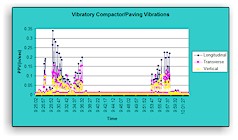 Even in the rare cases where one has reliable vibration monitoring data in hand, he usually cannot be certain that observed vibrations
are "safe" for all buildings in the construction area. The usually unknown details of structure types and interior finishes present, the statistical nature of the vibration limits set
by standards, the role of interference effects in enhancing or decreasing vibrations in a given location, the variable resistance of building materials and methods to vibration damage, and the often
variable and unknown degree to which ground vibrations are enhanced in homes by
amplification effects all contribute to some uncertainty regarding prediction of vibration safety. Vibration standard limits and safe distances speak, at most, only to probabilities, not certainties, even when properly chosen and applied. Even in the rare cases where one has reliable vibration monitoring data in hand, he usually cannot be certain that observed vibrations
are "safe" for all buildings in the construction area. The usually unknown details of structure types and interior finishes present, the statistical nature of the vibration limits set
by standards, the role of interference effects in enhancing or decreasing vibrations in a given location, the variable resistance of building materials and methods to vibration damage, and the often
variable and unknown degree to which ground vibrations are enhanced in homes by
amplification effects all contribute to some uncertainty regarding prediction of vibration safety. Vibration standard limits and safe distances speak, at most, only to probabilities, not certainties, even when properly chosen and applied.
Unfortunately, there are neither measurements nor calculations of the effects of construction vibration which can fully account for the combined (and synergistic) effects of vibration velocity, frequency and duration, so
as to be able to make meaningful damage risk estimates for every instance of construction with heavy equipment - or even for every operation. These interactions are so different from blasting effects in virtually every aspect that even the well-done blasting studies which exist have limited application in construction settings,
including even construction blasting. For more
discussion of these technical issues, see the CVDG Pro document Vibration and Homes. Some Recommendations With these qualifications in mind and a recognition that much research still needs to be done, we can suggest some elements which
can contribute to maximizing vibration "safety".
These include:
- scientifically relevant and defensible local and state vibration regulations, which set down ways of mitigating vibration, acceptable and meaningful limits for different activities, procedures for proper monitoring of and
feedback to construction crews on vibrations (for more, see Vibration Regulation), and enforcement mechanisms to ensure compliance with the regulations,
- careful, proper measurement and consideration of the detailed properties of the vibrations (including not only the peak particle velocity of the largest vibration, but the number of vibrations exceeding relevant
standards in a given episode, their frequency distributions, their durations and the integrated displacement associated with them),
- watchful supervision of construction operations to assure that they are done properly with an eye toward both mitigating vibration and following relevant standards (note the many violations of the FTA construction vibration
standards for the nearby homes in the record above) and equipment operator manuals,
- detailed documentation of home conditions, both before and after construction start,
- careful examination and consideration of reported damage, with an eye toward learning from it so as to minimize any further harm,
- acting upon damage reports with speed, good will and open-mindedness toward those who feel their homes have been damaged by construction work. A defensive denial of all responsibility will likely lead to litigation.
Responsibilities
Most vibration safety responsibilities rest ultimately with contractors and project sponsors. They have virtually all control over how the job is done, while nearby residents have virtually none. The contractor is paid to carry out the work
professionally and with due regard to the safety of nearby homes and people. Such concern for surrounding property owners is usually mandated by contract, either explicitly or in parts of the contract included by reference.
Some contracts may actually provide unintended incentives for irresponsible construction in the bonuses they award, or penalties they impose, regarding on-time completion. Faced with such financial incentives, construction
crews too often adopt risky procedures that even the contractor would not endorse. Sponsors sometimes contribute to damage by failing to perform basic due diligence in identifying damage possibility scenarios:
- using vibratory
contractors inside known safe distances,
- conducting pile driving applications without monitoring vibrations at nearby homes,
- depending solely on scaled distance equations to predict vibrations at home sites,
- driving tracked equipment on city streets,
- choosing the wrong equipment types to conduct a job),
- assuming that it's okay to exceed construction vibration limits just "a little",
- using inappropriate blasting vibration standards,
- and allowing completely unnecessary and predictably damaging operations (e.g. excavator pounding for pavement demolition) as a result of lax onsite supervision.
If it isn't possible to prevent absolutely all damage, then contractors should be held responsible in those examples where damage is traceable to, or likely to have been caused by, construction work. Repairing any such "unavoidable"
damage should be treated as a "cost of doing business" for the contractor and the project sponsor, not as something to be swept away with universal assertions (see Is Damage
Possible? in the CVDG Pro), lacking any accepted and credible scientific support.
[1] Assessment of Blast Vibration Impacts from Quarry Blasting in Dade County, David E. Siskind & Mark S. Stagg, May 10, 2000. This study also suggests a vibration velocity limit for that locale in Dade
County, Florida of 0.12 in/sec - a factor of four less than the USBM RI 8507 lowest standard of 0.5 in/sec.
[2] ANFO is "ammonium nitrate-fuel oil", a commonly-used explosive in mines and quarries. ANFO is widely used because it is relatively cheap, safe to handle and very powerful when detonated with a booster.
For more on blasting and the vibrations it produces, see the CVDG Pro chapter, Blasting Vibrations.
[3] Calculation of safe distances for vibratory compactors is described at:
https://www.dynapac.co.uk/en/knowledge/End-user-Support/Soil-Applications/ (go to
https://dynapac.co.uk , choose Knowledge, then
End-user-Support, then Soil Applications, if the direct link fails)
[4]
Structure Response and Damage Produced by Ground Vibration From Surface Mine Blasting, D. E. Siskind, M. S. Stagg, J. W. Kopp, and C. H. Dowding, United States Bureau of Mines Report of
Investigations 8507 (USBM RI 8507), 1980, p. 3
[5] While scaled distance and vibration propagation equations are widely used, they can be poor predictors of actual vibration intensities, due, in part, to vibration wave interference effects. In one example of vibratory compaction during a road
reconstruction job, one house experienced vibrations which were measured at 0.315 in/sec, in violation of both the FTA Class II, III and IV standards. Another measured a few minutes earlier 2 doors further up the same
street, essentially the same distance away from the paving operation, and using the same seismograph, had a measured vibration velocity of 0.660 in/sec, over a factor of two higher and in violation both of all FTA
vibration standards and the USBM RI 8507 blasting recommendations for homes with plastered walls. It is likely that these differences were due to vibration wave interference effects. This is a good illustration of
the potential hazards (both scientific and structural) of indiscriminate use of scaled distance calculations in construction settings without any confirming measurements.
[6] Seismic and Vibration Hazard Investigations of Chaco Culture National Historical Park, Kenneth W. King, S. T. Algermissen, and P. J. McDermott, USGS Open-File Report 85-529, 1985
Soil Applications,
https://www.dynapac.co.uk/en/knowledge/End-user-Support/Soil-Applications/ (go to https://dynapac.co.uk,
choose Knowledge, then End-user-Support, then Soil Applications, if the direct link fails)
Construction Practices to Address Construction Vibration and
Potential Effects on Historic Buildings Adjacent to Transportation Projects,
National Cooperative Highway Research Program (NCHRP), Project 25-25
(Task 72), Richard A. Carman, September 2012
Addendum, Vibration Report South Coast 101 High Occupancy Vehicle (HOV)
Lanes, K. J. Romero, California Department of Transportation, 2014
Assessment of Blast Vibration Impacts from Quarry Blasting in Dade County, David E. Siskind & Mark S. Stagg, May 10, 2000
[7] The Safe Distance vs. Propagation Exponent plot, and other similar plots, were created by algebraically rearranging the FTA equation to get the following algorithm for the log of the
minimum safe distance, Dmin:logDmin = log25-(logPPVequip - logPPVref)/n using the FTA Class III standard maximum velocity of 0.2 in/sec for PPVequip
and plotting against a range of values for n
[8]
"Therefore, for freshly renovated buildings and buildings in a poor condition a reduction of the limiting values is necessary. From experience it is known that such buildings have
effectively a reduced stiffness and thus in the standard they are put in the next lower category." Swiss Standard for Vibrational Damage to Buildings, J. Studer and A. Susstrunk, Proceedings, X. Int. Conf.
ISSMFE, Stockholm, Vol 3., pp. 309 (1981)
[9] Structure Response and Damage Produced by Ground Vibration From Surface Mine Blasting, D. E. Siskind, M. S. Stagg, J. W. Kopp, and C. H. Dowding, United States Bureau of Mines Report of Investigations 8507 (USBM RI 8507), 1980, pp. 58-60. These probabilities
represent the risk of damage to a group of homes of similar construction from a single blast producing a given PPV, not the risk of damage to a single home from multiple blasts.
According to the same study, also on p. 59, "For predictive purposes, the probability analysis results are more reliable. The lowest values of damage actually observed correspond quite closely to the 5-pct
damage probabilities, except for the high frequency data (set 6)." This observation provides support for the choice of the 5% damage probability level for the suggested
PPV limits. The free Vibrationdamage.com Ground Vibration PPV and Safe Distance Calculator includes a blasting damage probability calculator which allows you to estimate damage probabilities for a
given PPV.
|
|
| |
|