|
|
Vibration Signatures
Search Vibrationdamage.com
|
|
|
|

Search Vibrationdamage.com
|
|
However, a more careful and thoughtful analysis of vibration waveforms and frequency spectra can be a powerful tool in tracing ground vibration damage sources and causation. Different kinds of construction equipment and different kinds of activities leave different vibrational signatures on a seismograph trace, which can be useful in identifying the cause(s) of events. Here, we'll provide a few examples of some of these types of signatures and show how they can be used in a vibration damage instance to determine or disprove the cause of a given vibration. We'll also show that some activities which may seem benign from the standpoint of the velocity (PPV) of the ground vibration produced can turn out to be far worse from a vibration damage risk standpoint than they might seem. Although there are many types of construction heavy equipment and many types of operations possible with them, this chapter focuses on those operations and equipment types most likely to cause damage, especially when improperly used.
Vibratory compactors (as at left) are widely used in construction. They are known to exceed construction vibration standards in at least some circumstances, both generally and specifically speaking. Because such compactors have regular vibration frequencies which are set by the manufacturer for a given model or set by the operator, usually with operator-variable intensities, they stand out on both vibration waveform plots and the corresponding Fast Fourier Transform (FFT) frequency spectrum plots.
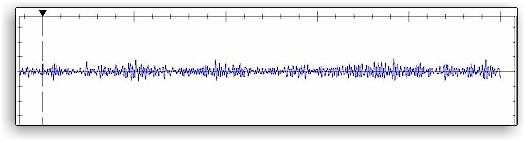
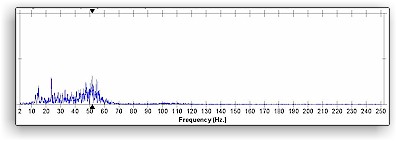
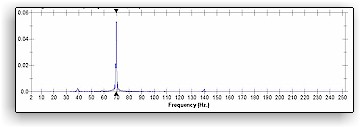
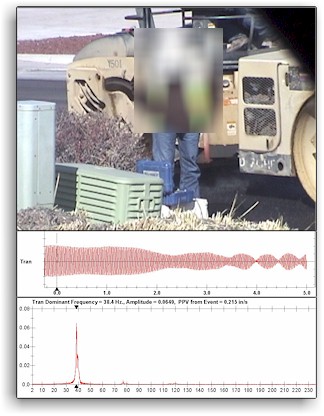
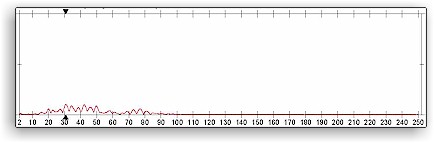
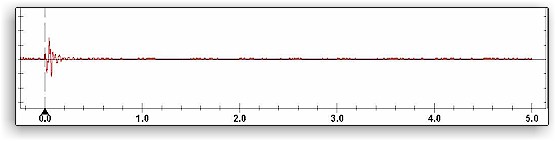
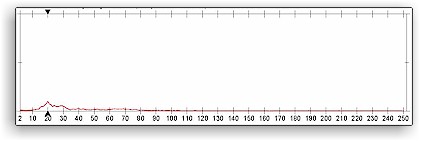
Above are shown the waveform (Figure 1a) and FFT frequency spectrum plots (Figure 1b) of a single vibration, known from video records to have been caused by the vibratory compactor shown above, an Ingersoll-Rand DD-70HF, passing approximately 40 feet from the seismograph transducer head. Only the longitudinal vector plots are shown, but the transverse and vertical vector waveform plots are virtually identical in this case. As can be seen in the waveform plot, these compactors produce highly regular vibrations. Reading the vibration waveform from left to right, the approach of the compactor causes the seismograph to exceed its trigger level and begin recording at the q symbol. The vibration grows as the compactor makes its closest approach, then wanes as it moves away over the 5 second recording time of the seismograph. Since this vibratory compactor has a nominal vibration frequency of 66.7 Hz,[3] the FFT vibration frequency spectrum is sharply peaked at that frequency. A tiny overtone is visible at twice the frequency and another tiny peak is at 38 Hz. The graphic at the right shows a video frame of the same vibratory compactor passing about 4 feet from the seismograph head at a precisely-known time and date. The image of the vibration technician is intentionally blurred. The waveform for the vibration produced from this passage and the corresponding FFT frequency spectrum are just below. Although this is the same DD-70HF compactor, its vibration shows a peak at 38 Hz, a minor peak in the vibration spectrum for the same compactor above, not the 66.7 Hz nominal frequency. The "beat" pattern of the waveform suggests that this "changed" dominant frequency is due to interference effects between the unsynchronized vibrations of the two drums on the compactor, as no other heavy equipment was within 100 feet of the compactor. These effects are a consequence of the close proximity of the compactor to the seismograph transducer. When vibrations are being generated by more than one piece of equipment, the resultant vibration waveforms and the corresponding FFT spectra are usually the algebraic sums (superimpositions) of the two compactors operating together. This is particularly visible in the FFT spectrum, which will show two sharp peaks at the vibration frequencies of the two compactors, as long as they are far enough away from the seismograph and each other that interference does not manifest itself. Although the practiced eye can look at the vibration waveforms and identify the source of the vibrations, the FFT spectra make the presence of different vibratory compactors easy to see. Impact Events Impact vibration events can occur in all sorts of construction settings, including demolition of pavement, dropping of heavy items on the ground (e.g. large rocks used as rip-rap around water courses), demolition of buildings, pile driving (see below) and so forth. Such events produce vibrations which look fundamentally different from those due to equipment like vibratory compactors or other equipment producing regular vibrations.
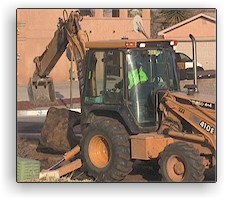
Above are shown the vibration waveform and the corresponding FFT frequency
spectrum (Figures 3a and 3b) of a vibration whose cause was recorded on video, as well as witnessed.
It resulted from a backhoe operator dropping about a half ton piece of concrete
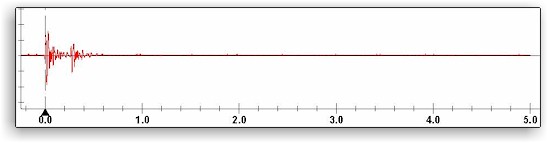
on the ground less than 6 feet from the seismograph (video frame capture at right). The second set of impact data (Figures 4a and 4b) depict a seismograph vibration record generated when using an excavator to pound on already broken asphalt to break it into smaller chunks, also captured on videotape. Here again, we have the same pattern of short duration, broad frequency distribution vibrations. In this case, the vibration source was about 60 feet from the seismograph, as documented on video. This pattern of short duration, broad frequency distribution vibration is characteristic of ground vibrations due to impacts, however generated. In a typical construction environment, where vibrations due to impacts may occur simultaneously with regular equipment vibrations, the two kinds of behavior may be superimposed on each other. They can usually be differentiated, since impacts are typically quite short (under 0.5 sec), while equipment vibration continues for the length of the vibration recording (usually several seconds). Pile Driving Pile drivers, especially impact-type hammer pile drivers, generate broad vibration frequency spectra similar to other types of ground impacts, like that shown in Figure 4b. No pile driving was done in the job from which the frequency spectra in this chapter were taken, which means that any pile driving vibration spectra we might show here would not be strictly comparable to the others. However, we have seen many other examples of jobs in which pile driver vibration spectra were recorded or could be generated from the data. To date, all of those other jobs utilized hammer-type impact pile drivers, not resonance pile drivers. The combination of broad frequency spectra, combined with the high velocities generated by pile drivers (reference velocities from .75 to 1.5 in/sec PPV) is usually suggestive of pile driving sources. Composite Events
The transverse vibration waveform below (Figures 5a and b) was caused by an excavator in a trenching operation. Again, the vibrations along the other vectors are similar.
The waveform is composed mostly of a regular set of repeating vibrations of unvarying overall intensity. Only in the first half second or so of the vibration is a small impact-related component seen - probably related to the impact of the excavator bucket with the earth. The FFT frequency spectrum shows a set of narrow, regular frequency machine vibrations superimposed on the much smaller and broader impact spectrum at the beginning of the event. Vibration Frequency Spectra in Use One can use waveform and FFT vibration data to ferret out errors or misrepresentations in a vibration damage case. The vibration technician in this case claimed in his report that the 0.3 second vibration in Figure 5a was caused by a "Garbage Truck Passing" (a direct quote from his report). Raw data file dates showed that the technician added the "Garbage Truck Passing" indication to the data three days after the 0.3 second vibration event. Since a passing garbage truck would approach the seismograph, pass it, and then recede from it, the regular intensity variation of the vibration waveform is inconsistent with a passing garbage truck. The barely visible, less than half second impact at the beginning of the vibration was only consistent with the trenching operation, since a garbage truck would have had to have been moving at an outrageously and incredibly high speed[6] to produce such a short duration vibration. The observed sharply peaked frequency distribution was also inconsistent with vehicles on rubber tires passing. Later information, obtained by subpoena, showed that a video-documented passage of a rubber-tired garbage truck within two feet of the seismograph transducer produced no detectable vibration whatsoever! The technician was forced to withdraw his claim, but only after numerous homes had experienced additional damage due to his clear misrepresentation of the cause of this vibration.[5],[6] Heavy Equipment Movement
Excavators,
bulldozers and other tracked heavy equipment must normally move short distances as they carry out their work. However, when they are moved large distances (e.g.
say more than 100 feet or so) at a time, they should be moved on trailers, not
simply "driven" along the street or over the work site. Tracked equipment
movement over distance (for more than 10 seconds in duration) can create very large vibrations in nearby structures, even
though the absolute magnitude of the ground vibrations generated may be
relatively small.
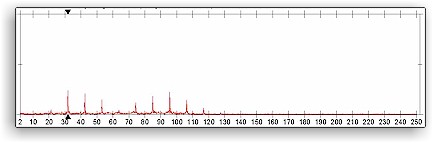
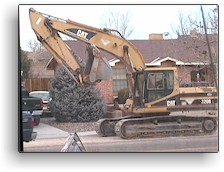
Figures 6a and b show the vibration waveform and corresponding FFT vibration spectrum associated with driving a large tracked excavator ("track hoe", a Cat 320 BL) along a city street for nearly a mile (see video frame grab above of this incident at left). The longitudinal axis vibration shown below, which is similar to those on the other axes, produced large structural vibrations, as recorded on videotape. The seismograph measured ground PPV of this vibration was only 0.085 in/sec, well within many construction vibration standards,[4],[7] but it still produced additional documented damage (extension of existing cracks and creation of new ones).
The vibration from the tracked excavator looks very much like the impact-related vibrations shown above, probably because the track segments impact the ground individually, one after another, as the excavator is driven. It also shows the same broad frequency distribution, extending well below the 40 Hz frequency regime "cutoff" discussed in USBM RI 8507[1] as most concerning for damage. However, unlike the sub-one-second impacts discussed above, this series of impact-like vibrations went on for over a minute in front of each monitoring location. The combination of the low vibration frequency and long duration is what makes tracked vehicle movements potentially damaging at intensities which might otherwise be considered "safe". Such "drive-by" incidents involving heavy equipment are known to produce ground accelerations exceeding those generated by use of vibratory compactors,[2] which are, themselves, known to exceed U.S. construction vibration standards. The tracked equipment drive-by example shows why vibration data must be carefully considered and analyzed. The vibration technician responsible for these data simply had no idea of the danger of these vibrations, because, as later sworn testimony by him showed, he never created the FFT frequency distribution reports and didn't really understand resonance phenomena brought into play by long-lasting vibrations (i.e. those lasting longer than a few seconds). He simply reported that the intensities were below the inappropriate OSM blasting standards - case closed, in his mind. Although driving heavy tracked equipment over distance is clearly risky, especially in urban environments, it is under-acknowledged as a source of damaging vibrations, perhaps because the ground vibrations themselves often have relatively low velocities. However, such movements can, and do, cause damage. This phenomenon of long duration, low frequency resonant interactions with homes shows why vibration data must be examined thoughtfully and critically to assess the real vibration damage risk from construction operations, not simply to provide a false sense of safety, based on the ground vibration velocity alone. Resonant interactions with the home and the "amplification" of the home vibration caused by them can turn a "safe" or "allowable" ground vibration into a patently unsafe home vibration. Other Vibration Sources Of course, there are many types of vibration-causing equipment used in construction jobs. This article doesn't encompass all of them, but discusses the ones most likely to cause damage in construction settings. Most other types of vibration on a construction job look much like one of the basic types discussed here. Using and understanding the waveform and frequency spectra of vibrations in tandem can be a powerful tool in spotting and dealing with false attributions and uncritical assessments of damage potential based solely on vibration peak velocities. Other, non-construction, vibration sources are discussed in Non-construction Vibrations in the CVDG.
|
|
|
E-mail to drzeigler@vibrationdamage.com or send online questions or comments about Vibrationdamage.com.
|

 All too
often, vibration monitoring data are "analyzed" by comparing a peak particle velocity
(PPV) to a vibration standard "compliance plot" of some sort, whether or not the standard shown in the compliance plot is appropriate for that vibration source or the properties of the vibration. The vibration is then pronounced to "meet standards". This kind of simple-minded and heavily-flawed understanding of
vibration measurements and their meaning constitutes the overwhelming majority of opinion that one sees from most vibration monitoring "professionals".
All too
often, vibration monitoring data are "analyzed" by comparing a peak particle velocity
(PPV) to a vibration standard "compliance plot" of some sort, whether or not the standard shown in the compliance plot is appropriate for that vibration source or the properties of the vibration. The vibration is then pronounced to "meet standards". This kind of simple-minded and heavily-flawed understanding of
vibration measurements and their meaning constitutes the overwhelming majority of opinion that one sees from most vibration monitoring "professionals".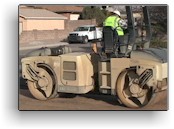 Vibratory Compactors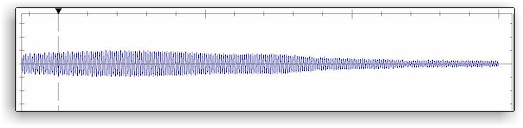
 Aside from the fact that
the impact vibration lasts a much shorter period of time than the compactor
vibrations above, the FFT frequency spectrum is completely different. It
covers a far greater range of frequencies and has many frequency components
(peaks) of close to the same velocity.
Aside from the fact that
the impact vibration lasts a much shorter period of time than the compactor
vibrations above, the FFT frequency spectrum is completely different. It
covers a far greater range of frequencies and has many frequency components
(peaks) of close to the same velocity. 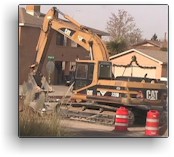 Often
construction vibrations will involve more than one kind of source, with the
different waveforms superimposed. Even then, the more complex shape of the vibration waveform
and its frequency distribution can tell us a lot about the source of the
vibration.
Often
construction vibrations will involve more than one kind of source, with the
different waveforms superimposed. Even then, the more complex shape of the vibration waveform
and its frequency distribution can tell us a lot about the source of the
vibration.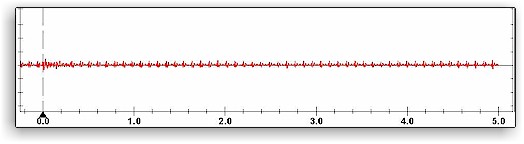
 This happens because of